
Reliable field data. Clear operational visibility.
Instrumentation systems have to function in harsh environments, over unreliable networks, often for years at a time. We design practical measurement, data acquisition and communications architectures for remote and distributed monitoring.
Geotechnical & structural instrumentation
Vibrating-wire and MEMS instruments are only as good as the chain behind them: excitation, sampling, timestamping, calibration records and the path back to a dashboard somebody trusts. We design that chain end to end.
Thresholds are set by the engineer responsible for the asset, not by software defaults. Raw channels are retained alongside processed values, so any alert can be reconstructed later, and the exports are usable by a reviewer who has to sign them.
- Piezometers
- Vibrating-wire and MEMS, with excitation and sampling appropriate to the instrument.
- Inclinometers
- In-place and portable arrays, with orientation and baseline handled properly.
- Load cells & strain
- Bridge and structural measurement, including temperature compensation.
- Acquisition
- Loggers, multiplexers and the field wiring detail that decides data quality.
- Telemetry
- LoRa, cellular and satellite backhaul, chosen per site and power budget.
- Alerting
- Threshold logic, escalation and an audit trail behind every notification.
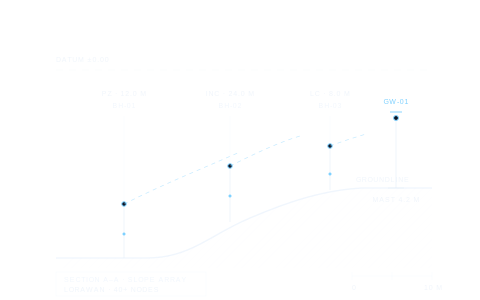
A section through a monitored slope
A typical array: three instrumented boreholes on a rising slope, each with its own instrument type and depth, reporting over long-range radio to a gateway with cellular backhaul. The engineering is in the sampling, the timing and the failure behaviour, not in the dots on the drawing.
Systems are specified to keep logging through a backhaul outage and to make the gap visible when they cannot. A record that omits its own outages is worse than no record.
What tends to go wrong
- Instruments outlive their installers
- Hardware with no documentation, spares or calibration path becomes scrap in three years.
- Dashboards nobody opens
- If an alert does not arrive where work is planned, the system is a report, not monitoring.
- Data that cannot be defended
- No raw record, no calibration reference, no clock discipline means nothing to stand behind.
- Coverage chosen by price
- A network that misses the one location that moves is a false negative, not a saving.
From sensor to decision
A monitoring system is a chain: sensor, logger, telemetry, platform, and then a person who has to decide something. Each link has a failure mode that looks like a quiet data problem. An uncalibrated sensor produces confident nonsense. A logger with a failing battery reports plausible values until it stops. A telemetry link that retries without idempotency duplicates readings and distorts a trend. A dashboard that nobody opens is not monitoring, it is decoration.
We specify the chain end to end: measurement range and resolution against the engineering question, sampling rates that match the physical process, power budgets that survive winter, and network paths that degrade gracefully. Where a site has no reliable power or connectivity, that constraint is designed around rather than wished away.
Data quality is the deliverable
Geotechnical and structural monitoring is only useful if the numbers can be defended years later. That means documented installation, calibration records, time synchronisation, gap detection, and a way to tell a real movement from a sensor that drifted. We build those checks into the pipeline rather than leaving them to whoever reads the chart.
Alarm thresholds get the same treatment. A threshold set from a single season of data will misfire in the next one, so we look at the physical mechanism, the rate of change that matters, and what the response will be at two in the morning when the alert arrives. The output is a monitoring system that an engineer, an insurer or a regulator can interrogate, not only a live graph.
Related expertise
Commissioning and the first month
A monitoring installation is not finished when the last sensor reports. Commissioning is where a design is proved: baseline readings taken over a period long enough to see normal behaviour, thresholds checked against real noise, alerts tested end to end to the person who will act on them, and the failure modes rehearsed deliberately. A power cut, a dropped link and a flat battery should each produce a known, visible result.
The first month is treated as part of the work rather than the end of it. Readings are reviewed against expectations, sensors that drift or read implausibly are investigated, and the alarm thresholds are adjusted with evidence. That is also when documentation gets corrected, because the site always differs from the drawing somewhere.
Tell us the asset and what happens if it fails.
That single answer usually decides the architecture before any hardware is discussed.